The video above puts two of the great .357 Magnum revolvers side by side: the Smith & Wesson Model 27 and the Colt Python. The comparison and the range time are the creator’s work, so give it a watch and judge for yourself. What I can add is the view from a gunsmith’s bench, because these two revolvers answer the same question in very different ways. I’m Lance Rankin, owner of Western Sport in Roanoke, Texas.
Shop the gear in this guide
-
Add to cart

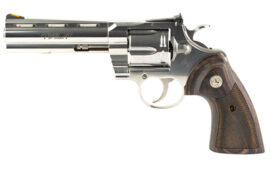
Colt’s Manufacturing Python, 357 Magnum, 5″, Silver, 6 Rounds, Colt Python 5″ Stainless Steel, Stainless Steel
$1,699.00 -
Add to cart
Smith & Wesson 686 Plus, Double/Single Action, 357 Magnum/.38 Special, 4.13″ Barrel
$2,199.00 -
Sale!Add to cart

Colt’s Manufacturing King Cobra Carry .357 Mag Revolver, 3″ Barrel
Original price was: $1,149.00.$999.00Current price is: $999.00. -
Add to cart
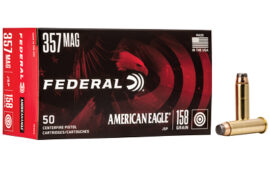
Federal American Eagle, 357MAG, 158 Grain, Jacketed Soft Point, 50 Round Box
$54.99


The Model 27: built like a vault
The Model 27 descends directly from the Registered Magnum of the 1930s, a revolver premium enough that buyers registered each one with the factory, Depression economy be damned. It sits on Smith & Wesson’s big N-frame, and that was the whole point. When the .357 Magnum cartridge arrived, it needed a frame with enough steel to contain it, and the N-frame’s thick forcing cone and stout lockup spread that abuse where it does the least harm.
That’s why the Model 27 carries the workhorse reputation. It’s a revolver you can feed full-power magnum loads for decades. The weight that makes it a commitment on the hip is the same weight that makes a long magnum session civilized.
The Python: Colt at its most ambitious
The Python arrived in 1955 and looked like nothing else, with its ventilated rib and full-length underlug under Colt’s famous royal blue polish. Beneath the looks was a great deal of skilled handwork. Fitters tuned each action, and the bore was slightly tapered toward the muzzle, an old accuracy trick intended to improve the bullet’s seal on its way out. That hand labor is why Pythons cost so much, and eventually why Colt struggled to build them profitably. The gun went in and out of production before the modern reissue brought it back.
The trade-off shows up on benches like mine. Colt’s older action design can drift out of time under a steady diet of heavy magnum loads, and vintage Pythons with worn timing are a known quantity among revolver smiths. That doesn’t make the Python fragile. It makes it a gun that rewards mechanical sympathy.
Details worth knowing
The two even rotate in opposite directions: the Python’s cylinder turns clockwise, the Smith’s counter-clockwise. Balance differs too. The Python’s underlug makes it distinctly muzzle-heavy, which many shooters like for hanging steady on target, while the Model 27 balances closer to the hand. Neither is wrong. Ten minutes of dry handling will tell you which one your hand prefers.
Both guns exist in modern production now, in stainless and in various barrel lengths, and the current guns shoot well. The vintage examples are where the collector money lives, and prices reflect it.
Model 27 vs Colt Python: which one?
If I’m buying one revolver to shoot hard with magnums for the rest of my life, it’s the Model 27, and it isn’t close. If I’m buying a piece of American gunmaking at its most ambitious, the Python is the answer, and shooting it gently is no great sacrifice. For a lot of collectors the honest answer is eventually both.
Vintage revolvers turn up online constantly, and buying one from out of state just means shipping it to a local dealer. Here’s how buying a gun online works, and my shop handles transfers. If you land an old Python or a pinned-and-recessed Smith and want its timing and lockup checked before you shoot it, that inspection is exactly the kind of work I enjoy. If you want a new .357 instead, the store carries the Colt Python 5 inch stainless, the Smith & Wesson 686 Plus (the L-frame that took over the Model 27’s working role) and the snub Colt King Cobra Carry, plus .357 Magnum ammunition from Federal American Eagle 158 grain practice loads to Hornady Critical Defense. Order online and we ship to your local FFL, or email [email protected] with questions.
Model 27 vs Python questions
Which handles full-power .357 loads better, the Model 27 or the Python?
The Model 27. Its N-frame was built around the .357 Magnum from the start, with a thick forcing cone and stout lockup. Older Pythons can drift out of time under a steady diet of heavy magnum loads.
Do the Model 27 and the Python cylinders rotate the same way?
No. The Python’s cylinder turns clockwise and the Smith & Wesson’s turns counter-clockwise. Balance differs too: the Python’s full underlug makes it muzzle-heavy, while the Model 27 balances closer to the hand.
Are the Model 27 and the Colt Python still in production?
Both exist in modern production in stainless and several barrel lengths, and the current guns shoot well. Vintage examples are where the collector money lives.

Lance Rankin is the owner and Chief Gunsmith of Western Sport, a family-run Type 07 FFL and Class 3/SOT dealer in Roanoke, Texas, serving shooters since 2007. Born and raised in Texas with over 50 years of experience handling firearms, Lance purchased Western Sport in 2017 and turned his lifelong passion into his profession. He specializes in AR-15 and AR-10 platform rifles, manufactures Western Sport’s own Rankin Industries parts and rifles, and runs the shop’s in-house Cerakote coating operation. When he’s not behind the counter or the workbench, you’ll find him on his ranch deep into the night, hunting coyotes with an AR-15 and thermal optics. Lance holds an MBA and personally shoots and tests the products Western Sport sells.