


A forced reset trigger (FRT) is a semi-automatic trigger that uses the rifle’s own cycling to push the trigger forward to its reset point after every shot. You still pull the trigger once for each round fired, but you no longer wait for your finger to let the trigger reset, so follow-up shots come much faster. Below: how an FRT works, how it differs from a binary trigger and a “super safety,” what your rifle needs to run one, where FRTs stand legally, and the forced reset triggers and selectors we ship to your door.
Forced reset trigger at a glance
- What it is: a trigger (or trigger system) that mechanically forces the trigger forward to reset as the bolt carrier or slide cycles.
- Rounds per pull: one. Each shot still takes a separate function of the trigger.
- Main types: drop-in AR-15 FRTs such as the Rare Breed FRT-15L3, forced reset selectors (“super safeties”) such as the Atrius Forced Reset Selector, and pistol or rimfire FRTs such as the TX22 FRT.
- What an AR needs: a full-auto (M16) profile bolt carrier group and usually an H2 or H3 buffer. Most problems trace back to the carrier or buffer.
- Federal status: after the May 2025 Department of Justice settlement with Rare Breed Triggers, FRTs that fire one round per function of the trigger are not being treated as machine guns. Several states restrict or ban them. See Are FRT triggers legal?
- Buying one: an FRT is a part, not a firearm. No FFL transfer and no tax stamp. It ships to your door in states we can ship to.
How a forced reset trigger works
On a standard AR-15 trigger, the hammer falls, the bolt carrier cycles and re-cocks the hammer, and then nothing happens until you let the trigger travel forward far enough to reset. That reset is the speed limit on a normal trigger.
A forced reset trigger removes that wait. The sequence on an AR-15 FRT looks like this:
- You pull the trigger and the hammer falls. One round fires.
- The bolt carrier travels rearward and rolls the hammer back.
- As the hammer is pushed back, the FRT uses that movement to drive the trigger forward against your finger, resetting it. A locking feature keeps the hammer from following the carrier until the bolt is back in battery.
- The trigger is now reset. Keep forward and rearward pressure on it and it is ready for the next pull almost immediately.
The key point, mechanically and legally, is that the shooter still pulls the trigger once for every round. The rifle is faster because the reset is forced, not because it fires on its own.
FRT vs binary trigger vs super safety vs standard trigger
| Type | What you replace | How it fires | Typical AR requirements | Example we carry |
|---|---|---|---|---|
| Standard trigger | Nothing | One round per pull; you wait for the trigger to reset on its own | Any semi-auto carrier | — |
| Forced reset trigger (FRT) | The whole fire control group (drop-in) | One round per pull; the carrier forces the trigger to reset | Full-auto (M16) bolt carrier, H2/H3 buffer | Rare Breed FRT-15L3 |
| Forced reset selector (“super safety”) | Only the safety selector; your trigger stays | One round per pull in a third “super-semi” position | Full-profile bolt carrier, H2/H3 buffer, compatible mil-spec trigger | Atrius Forced Reset Selector |
| Binary / echo trigger | The whole fire control group | One round on the pull and one on the release | Varies by model; many call for an M16 carrier | — |
If you are torn between the two forced reset styles, our super safety vs FRT comparison walks through cost, install and compatibility side by side.
Types of forced reset triggers
Drop-in AR-15 forced reset triggers
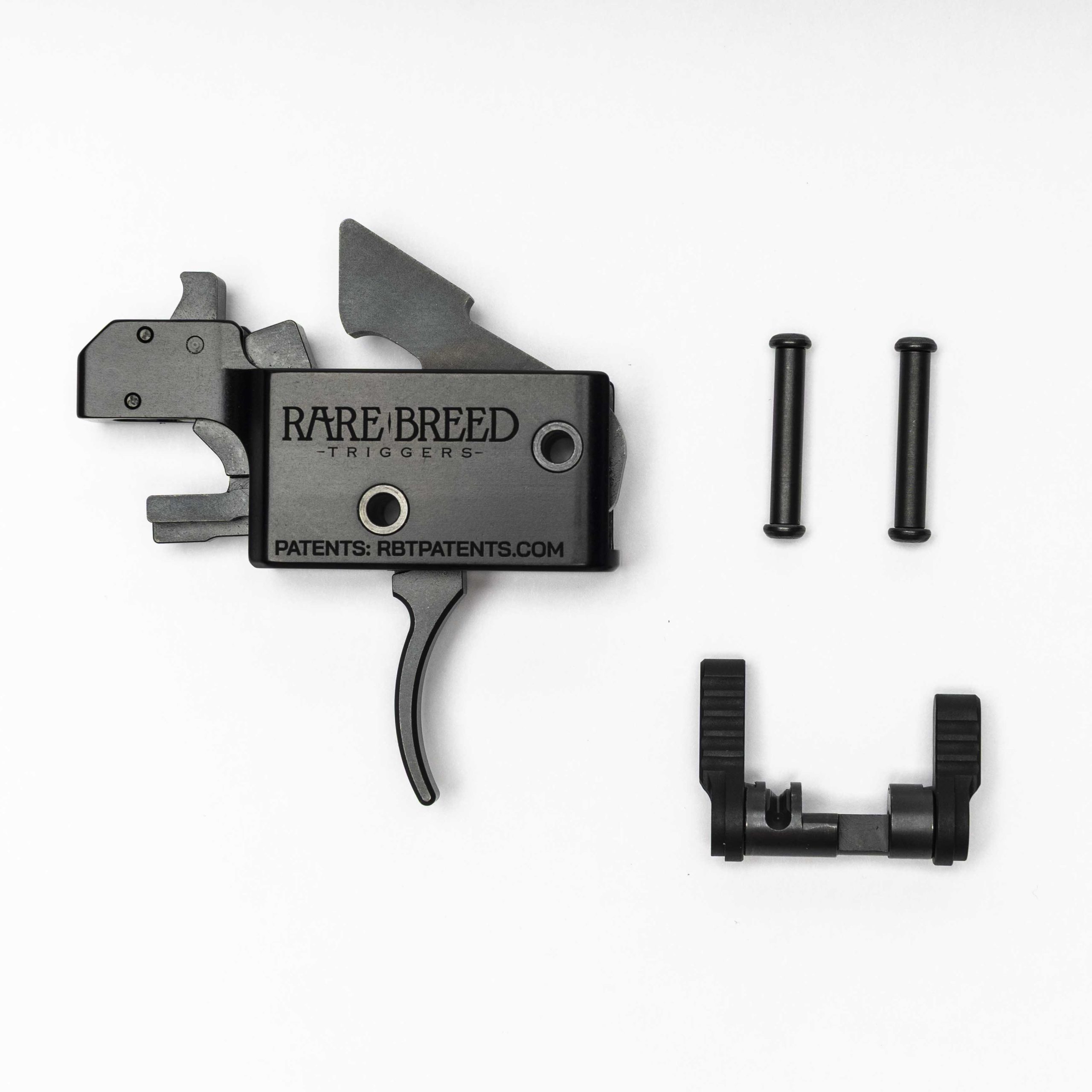
A drop-in FRT replaces your trigger, hammer and disconnector with one housing that sits in the standard trigger pin holes. The Rare Breed FRT-15L3 is the best known. Rare Breed describes it as a single-stage, three-position (Safe / Semi / FRT) forced reset trigger for mil-spec AR-15 lowers, and it comes with its own selector, anti-walk pins and screws.
Forced reset selectors (the “super safety”)
A forced reset selector does the reset work from the safety selector instead of the trigger group. You keep a compatible mil-spec trigger and swap only the selector, which adds a third position. Atrius Development Group calls theirs the Forced Reset Selector (FRS); shooters also call it the Atrius “Super Selektor.” We carry the single-sided FRS, the Mil-Spec Ambi, the G-Lever Ambi for Geissele SSA, SSA-E and G2S triggers, plus the Ambi 3-Position Forced Reset Selector, an unbranded ambidextrous option. Fit and setup are covered in our Atrius forced reset selector guide.
Pistol and rimfire FRTs
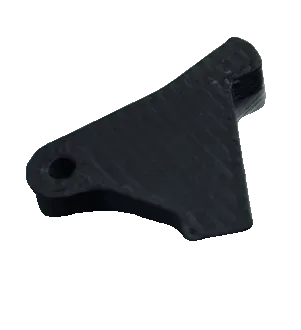
Some pistols take a small drop-in part that does the same job. The most popular is the TX22 FRT, which replaces the disconnector in a Taurus TX22 and uses the slide’s travel to reset the trigger. Installation is covered step by step in our TX22 FRT installation guide.
MP5-pattern super safety lowers
MP5 clones such as the Century AP5, PTR 9 and HK SP5 can run a super safety in a complete trigger housing. The Lee Sporting LS5 MP5 super safety lower comes assembled; our MP5 super safety guide explains which version fits your gun.
What your AR-15 needs to run an FRT
Forced reset devices depend on the bolt carrier returning with enough speed and mass to push the trigger forward. That is why the rest of the rifle matters more than it does with a standard trigger.
- Bolt carrier group: a full-auto (M16) profile carrier. Rare Breed says a full-auto-compatible BCG is required for the FRT-15L3, and Atrius requires a full-profile BCG for its selectors. Semi-auto carriers with the cut-away bottom will not reset the trigger reliably. We stock M16-profile carriers from Rankin Industries, Daniel Defense, Faxon and Phase 5.
- Buffer: Rare Breed recommends an H2 or H3 buffer (or an A5 system), and Atrius lists H2 or H3 as a minimum. A heavier buffer is the usual fix for light primer strikes and bolt bounce. See our buffers and buffer tube kits.
- Lower receiver: a standard mil-spec AR-15 lower. Rare Breed notes the FRT-15L3 may not fit some Colt models or lowers with a sear block. Atrius selectors need a low-shelf or full-profile trigger pocket and will not work in high-shelf lowers.
- Caliber and platform: both Rare Breed and Atrius design around .223 / 5.56 and .300 Blackout AR-15s. Neither supports the AR-10 platform, and AR-9 builds may need gunsmithing.
- Gas: a properly gassed rifle. Undergassed or worn rifles are where reset problems start.
Which forced reset trigger should you buy?
- You want to keep your trigger and spend less (most AR-15 owners): a forced reset selector. The Ambi 3-Position Forced Reset Selector gives you levers on both sides; the Atrius Forced Reset Selector is the single-sided option, the Atrius Mil-Spec Ambi has a traditional mil-spec switch on both sides, and the Atrius G-Lever is for Geissele SSA, SSA-E or G2S triggers.
- You shoot a Taurus TX22: the TX22 FRT is the cheapest way into the category.
- You shoot an MP5 clone: the Lee Sporting LS5 super safety lower.
- Your trigger is not selector-compatible: a drop-in FRT that replaces the whole trigger group, such as the Rare Breed FRT-15L3, avoids the problem.
- You want two shots per pull-and-release instead: that is a binary trigger, a different mechanism with its own legal profile.
Are forced reset triggers legal?
At the federal level, the Department of Justice settled its litigation with Rare Breed Triggers on May 16, 2025, and ATF began returning seized FRT-15 and Wide Open Trigger devices. Under that settlement, FRTs that fire one round per function of the trigger are not being treated as machine guns. A settlement is an enforcement agreement, not a new law, and state law is separate: several states and some cities restrict or ban forced reset and other rate-increasing devices. We do not ship FRTs or forced reset selectors to California, Colorado, Connecticut, Delaware, the District of Columbia, Florida, Hawaii, Illinois, Iowa, Maryland, Massachusetts, Minnesota, Nevada, New Jersey, New York, Oregon, Rhode Island, Virginia or Washington, or to U.S. territories or outside the United States. The full picture, including Texas, is in our guide Are FRT triggers legal in 2026? Nothing here is legal advice.
Installing and running an FRT reliably
- Unload and clear the rifle first, and keep ammunition out of the room.
- Follow the maker’s instructions for your exact model. Rare Breed publishes installation videos; Atrius recommends blue thread locker on the selector screw (T10, 4-40) torqued to 15 in-lb.
- Do a full function check unloaded in every selector position before live fire.
- Start with two rounds in the magazine, then five, then a full magazine.
- Hold steady forward pressure on the trigger in forced reset mode. Fighting the reset is the most common shooter-side cause of “dead trigger” complaints.
- If it short-strokes or light-strikes, check the carrier profile, step up the buffer weight, and confirm the rifle is properly gassed before blaming the trigger.
Forced reset trigger FAQ
What is an FRT trigger?
FRT stands for forced reset trigger. It is a semi-automatic trigger that uses the rifle’s cycling to push the trigger forward to its reset point after each shot, so the next pull is available almost immediately. It still fires one round per pull of the trigger.
Is a forced reset trigger the same as a machine gun or an auto sear?
No. A machine gun fires more than one round with a single function of the trigger. A forced reset trigger fires one round per pull; it only speeds up the reset. Devices that make a rifle fire automatically, such as auto sears and “switches,” are machine guns under federal law and are not FRTs.
Can you legally buy an FRT?
In most of the United States, yes. Federally, FRTs that fire one round per function of the trigger are not being treated as machine guns after the May 2025 settlement between the Department of Justice and Rare Breed Triggers. Some states and cities ban or restrict them, and we do not ship to those places. Check your own state and local law before ordering.
Do I need an FFL or a tax stamp to buy a forced reset trigger?
No. A forced reset trigger is a firearm part, not a firearm or an NFA item, so there is no FFL transfer and no tax stamp. It ships directly to your address if you live in a state we ship to.
Which is faster, an FRT or a binary trigger?
They work differently. A binary trigger fires once when you pull and once when you release. A forced reset trigger fires once per pull but resets almost instantly, so the rate depends on how fast you can pull. Many shooters find an FRT easier to control because it behaves like a normal trigger.
Can you put an FRT trigger on any gun?
No. Each FRT is built for a specific platform. The Rare Breed FRT-15L3 and Atrius selectors are for mil-spec AR-15s chambered in .223/5.56 and .300 Blackout, not AR-10s. The TX22 FRT fits only the Taurus TX22 family. MP5 clones use a super safety lower such as the Lee Sporting LS5.
What bolt carrier do I need for a forced reset trigger?
A full-auto (M16) profile bolt carrier group. Rare Breed lists a full-auto-compatible BCG as required for the FRT-15L3, and Atrius requires a full-profile BCG. Most failures to reset come from semi-auto carriers or a buffer that is too light.
Which forced reset trigger is the best?
It depends on what you want to change. For most AR-15 owners a forced reset selector, such as our own Ambi 3-Position Forced Reset Selector or an Atrius Forced Reset Selector, is the simplest choice because it keeps your trigger and costs less than a drop-in FRT. If your trigger is not selector-compatible, a drop-in FRT replaces the whole trigger group. For a Taurus TX22 the TX22 FRT is the obvious choice, and for MP5 clones a complete super safety lower is the simplest route.
Shop the category: every forced reset trigger and selector we carry is on one page, Forced Reset Triggers. They ship to your door with no FFL, to every state not on our restricted list. Questions about fit before you order? Send us a message.
Last reviewed October 3, 2026. Product requirements are taken from Rare Breed Triggers and Atrius Development Group; legal status summarizes public sources and is not legal advice.