Short answer: you no longer have to register an SBR in Texas. Since October 9, 2026, ATF no longer requires a Form 1, Form 4, tax stamp, fingerprints, photos or registration for a short-barreled rifle. A factory SBR now transfers on a standard Form 4473 with a NICS background check, the same as any other rifle, and you can build one without waiting on ATF. Two things still apply: your state’s law, and an approved ATF Form 5320.20 before you take an SBR across state lines.
I’m Lance Rankin. I run Western Sport, a Type 07 FFL and SOT dealer, and Western Sport sells the Rankin Industries line of parts and rifles. For years this page walked you through the Form 1 and Form 4 process step by step. That process is gone for SBRs, so here is what buying, building and owning one looks like now.
- Federal registration: not required since October 9, 2026.
- Tax stamp: none. The tax went to $0 on January 1, 2026, and the stamp itself went away on October 9, 2026.
- Buying a factory SBR: Form 4473 and a background check through an FFL.
- Building one: no approved Form 1 needed. You still cannot make them as a business without the right license.
- Crossing state lines: approved ATF Form 5320.20 still required.
- Texas law: Texas took short-barreled firearms off its prohibited-weapons list on September 1, 2025.
What changed on October 9, 2026
Three things happened this year. On January 1, 2026, the One Big Beautiful Bill Act cut the federal tax on SBRs, short-barreled shotguns, suppressors and AOWs from $200 to $0. On August 5, 2026, a federal court in the Northern District of Texas ruled in Silencer Shop Foundation v. ATF that with no tax left to collect, the registration and approval rules for those items could not be enforced against the plaintiffs. Then on October 9, 2026, ATF published an update to its NFA transfer guidance applying that outcome to everyone: no approval, no registration and no tax stamp for SBRs, SBSs, suppressors and AOWs.
Machine guns and destructive devices were not part of it. They keep the $200 tax and the full ATF process. Here is the full rundown of what changed.
What still makes a rifle an SBR
The definition did not change. Under federal law a rifle is a short-barreled rifle if its barrel is under 16 inches, or its overall length is under 26 inches. That matters less for paperwork now, but it still matters for state law, for travel, and for knowing what you own.
How to measure barrel length
Close the bolt, drop a dowel rod down the bore until it touches the bolt face, and mark it at the muzzle. A muzzle device counts toward barrel length only if it is permanently attached, meaning pinned and welded, high-temperature silver soldered or blind pinned. A 14.5-inch barrel with a pinned and welded flash hider that brings it past 16 inches is a rifle. The same barrel with a screw-on brake is an SBR. Our AR-15 barrel length guide covers which length fits which job.
How to measure overall length
Measure parallel to the bore from the muzzle to the back of the stock. A folding or collapsing stock is measured fully extended. If a rifle with a 16-inch barrel somehow comes in under 26 inches overall, it is still an SBR.
Buying a factory SBR in Texas
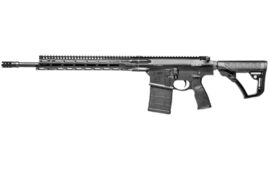
A factory-built SBR, like a 10.3-inch Daniel Defense MK18 SBR or a 9mm Angstadt Arms UDP-9 PDW SBR, now sells like any other rifle. You order it, your dealer runs the background check, you fill out a Form 4473, and you take it home when the check clears. No fingerprints, no photos, no months of waiting.
Ordering online from us works like this: put your own name and address under Billing, type your FFL dealer’s business name and address in the Order notes box at checkout, and have the dealer email a copy of their FFL to [email protected]. We ship the rifle to that dealer, and you finish the Form 4473 there. Outside Texas, we ship SBRs to an SOT dealer in your state. Browse SBRs and other NFA firearms in stock or the MK18 rifles and parts. If you are weighing a factory MK18, our Daniel Defense MK18 SBR setup guide walks through the build-out.
Building your own SBR
Before October 9, 2026, putting a short upper on a rifle lower with a stock meant filing a Form 1, engraving the receiver and waiting for approval first. ATF no longer requires that approved Form 1. If your state allows SBRs, you can put a short upper on your lower and run a real stock on it.
Two cautions. First, an unlicensed person still cannot make SBRs as a business; that takes the right FFL and SOT. Second, check your state before you assemble anything, because some states still ban short-barreled rifles or only allow ones registered with ATF. Rankin Industries complete AR-15 uppers drop onto any mil-spec lower, so a short Rankin upper on the lower you already own is the quickest way to an SBR.
SBR or AR pistol?
For years the AR pistol existed to dodge the Form 1. With that paperwork gone, the choice comes down to how you want to shoot it. A real stock gives you a solid cheek weld and a repeatable shoulder position, which most people shoot better with. A pistol with a brace or bare buffer tube is still the right call if you live in a state that bans SBRs, if you travel across state lines often and don’t want to file a Form 5320.20 each time, or if your state’s carry rules treat pistols differently.
Taking an SBR across state lines
This is the one federal step that did not go away. Before you take an SBR or short-barreled shotgun into another state, file ATF Form 5320.20 and wait for it to come back approved, whether or not the rifle was ever registered. Suppressors do not need a 5320.20. Check the law in every state on your route as well as your destination; a federal approval to transport does not make an SBR legal in a state that bans it.
Already own a registered SBR?
Nothing bad happens to it. Keep your approved Form 1 or Form 4 with your records. It answers questions quickly if you ever sell the rifle, move to a state that cares about federal registration, or file a Form 5320.20. If you want to sell it, it now transfers through a dealer on a Form 4473 like any other rifle.
Frequently Asked Questions
Is an SBR legal in Texas?
Yes. Texas removed short-barreled firearms from its prohibited-weapons list on September 1, 2025, and since October 9, 2026 ATF no longer requires federal registration for them.
Do I need to register an SBR in Texas in 2026?
No. Since October 9, 2026, ATF no longer requires a Form 1, Form 4, tax stamp or registration for a short-barreled rifle. A factory SBR transfers on a standard Form 4473 with a background check.
Is there still a tax stamp for an SBR?
No. The federal tax went to $0 on January 1, 2026, and the stamp went away on October 9, 2026.
What barrel length makes a rifle an SBR?
A barrel under 16 inches, or an overall length under 26 inches. Measure the barrel from the closed bolt face to the muzzle; only a permanently attached muzzle device counts.
Can I take my SBR to another state?
Only with an approved ATF Form 5320.20, and only into states where SBRs are legal. That requirement did not change on October 9, 2026.
Do machine guns work the same way now?
No. Machine guns and destructive devices still carry the $200 tax and the full ATF approval and registration process.

Lance Rankin is the owner and Chief Gunsmith of Western Sport, a family-run Type 07 FFL and Class 3/SOT dealer in Roanoke, Texas, serving shooters since 2007. Born and raised in Texas with over 50 years of experience handling firearms, Lance purchased Western Sport in 2017 and turned his lifelong passion into his profession. He specializes in AR-15 and AR-10 platform rifles, manufactures Western Sport’s own Rankin Industries parts and rifles, and runs the shop’s in-house Cerakote coating operation. When he’s not behind the counter or the workbench, you’ll find him on his ranch deep into the night, hunting coyotes with an AR-15 and thermal optics. Lance holds an MBA and personally shoots and tests the products Western Sport sells.